
What a Condo Management Agreement Should Include
A condo management agreement should say exactly what the manager does, what it costs, who controls the money, and how either side can leave. If any of those four are vague, the board carries the risk. Here is what to look for before you sign or renew. 1. Scope of services List what is included,…
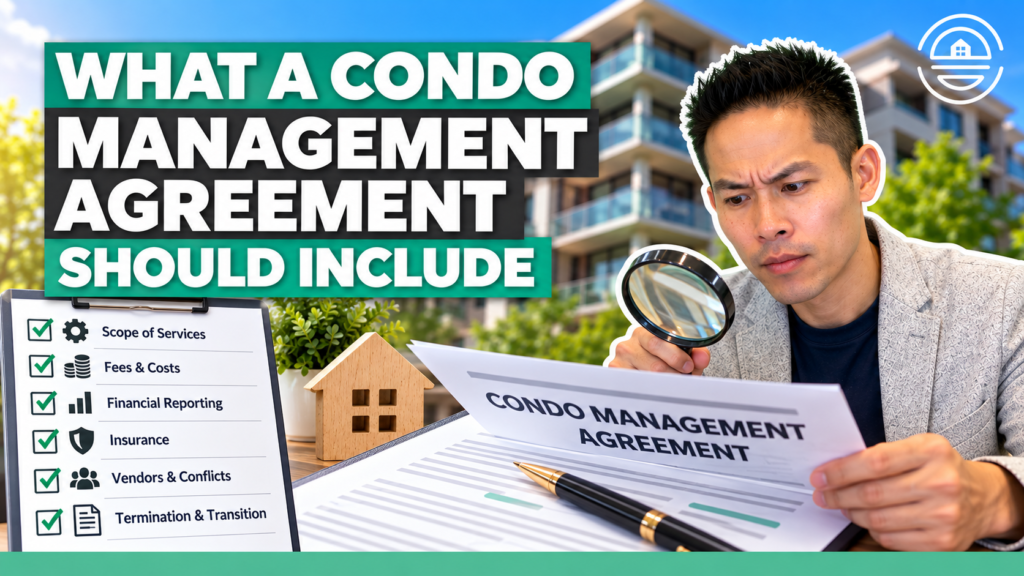
A condo management agreement should say exactly what the manager does, what it costs, who controls the money, and how either side can leave. If any of those four are vague, the board carries the risk. Here is what to look for before you sign or renew.
Table of Contents
1. Scope of services
List what is included, in plain language. Typical items: collecting assessments, paying bills, preparing budgets, coordinating maintenance and vendors, running owner communications, attending meetings, and keeping records. Anything not listed is usually an extra. Ask for the extras in writing.
2. Term and renewal
Check the length of the term and whether it renews automatically. Many agreements roll over unless notice is given by a set date. Put that date on the board calendar the day you sign.
3. Fees and extras
Look for the base monthly fee, and a clear list of what costs more. Common extras are project oversight, collections work, after-hours calls, additional meetings, and administrative charges. Ask how fee increases are handled and whether they need board approval.
4. Authority and spending limits
The agreement should state what the manager can approve alone and what needs board approval. A dollar limit per item is common. Emergency spending should be allowed, with a requirement to notify the board quickly.
5. Control of association funds
Funds should be held in accounts in the association’s name. The agreement should say who has signing authority, how reserve funds are kept separate, and how often bank statements are reconciled. Boards should be able to see the bank accounts directly.
6. Financial reporting
Define what reports the board gets and how often, such as monthly financials, a delinquency report and a budget-versus-actual comparison. Also define who prepares the annual budget and how the board gets it.
7. Records
The association’s records belong to the association. The agreement should say so, and say how and how fast the manager returns them when the contract ends. Ask for a records list and an electronic copy requirement.
8. Insurance
Ask for proof of the manager’s coverage: general liability, professional liability, and coverage for employee dishonesty or crime that applies to funds the manager handles. The association should be named where appropriate and receive certificates.
9. Vendors and conflicts of interest
The agreement should require competitive bids above a set amount and disclosure of any relationship between the manager and a vendor, including in-house maintenance. Ask whether the manager receives rebates or referral fees.
10. Emergency response
Define who answers after hours, what counts as an emergency, and how fast the manager must respond. “24/7 service” should be described, not just stated.
11. Termination and transition
This is the clause boards read last and regret most. Look for: termination for cause and for convenience, the notice period, how notice must be sent, a cure period, any termination fee, and the manager’s duties to hand over records, funds and information. See how to terminate a condo management contract in Massachusetts.
12. Liability and indemnity
Read who is responsible for what, and whether the association agrees to cover the manager for claims. These clauses are easy to skim and expensive to ignore. Association counsel should review them.
Before you sign
- Compare the draft against your master deed and bylaws.
- Have association counsel review it.
- Score it against other proposals with the Management Company Scorecard (free download).
- Put the renewal and notice dates on the board calendar.
Frequently asked questions
What is the most important clause in a condo management agreement?
The termination clause. It decides how and when you can leave, what it costs, and what the manager must hand back. Read it first.
Should a management agreement renew automatically?
Many do. If yours does, note the notice deadline and calendar it. A board that misses the date can be locked into another term.
Who owns the association’s records?
The association does. The agreement should require the manager to return them promptly when the contract ends.
Should a lawyer review the agreement?
We recommend it. Association counsel can check the agreement against your governing documents and Massachusetts law before you sign.
Part of our guide to hiring, switching or firing a condo manager. Questions about your agreement? Contact Green Ocean.
This article is general information, not legal advice. Contract terms vary. Have association counsel review your agreement.

Should Your Condo Board Just Save More Instead of Paying for a Reserve Study?
Short version: a reserve study doesn’t tell your board to save more. It tells you what order to spend in: what’s urgent and what can wait. Without one, most boards over-save for the thing that’s fine and under-save for the thing that isn’t. The question we hear most “Couldn’t we just save more instead of…
Is Property Management in Waltham Worth It? A Guide for Rental Owners
For most Waltham rental owners, a property manager is worth it once you own more than a unit or two, don’t live nearby, or just don’t want to be the one fielding a 2am maintenance call. The typical fee runs around 8 to 12 percent of collected rent, and a good manager usually earns that…

Standing Out Online: Optimizing Your Rental Listings for Maximum Exposure
In today’s digital age, attracting qualified tenants often hinges on creating compelling online rental listings. By optimizing your listings for maximum exposure, you can significantly increase your chances of finding the perfect renter quickly and efficiently. This guide will equip you with the key strategies to make your rental property shine online. Keys to…
4.9 stars on 1,000+ Google reviews. Managing Boston property since 1977.