
Reserve Studies for Massachusetts Condos: How Much Should You Be Saving?
A reserve study is the plan that keeps a $200,000 roof from becoming a surprise special assessment. Here is how reserve studies and funding work for a Massachusetts condo.
Updated October 8, 2026: Corrected the Massachusetts reserve requirement and lender dates, replaced generic percentage benchmarks with building-specific planning, and added official references.
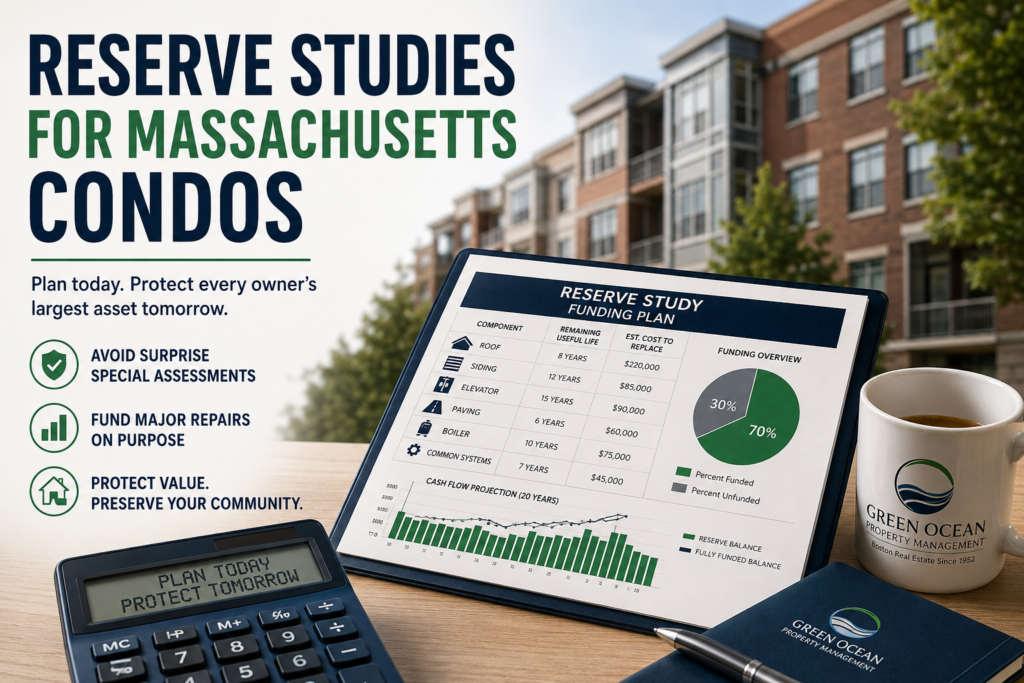
A reserve study inventories major common components, estimates their remaining useful lives and replacement costs, and develops a funding plan. It helps a board compare expected capital work with available funds. It cannot guarantee that a building will never need a loan or special assessment.
Table of Contents
What does a reserve study include?
- Component analysis: items such as the roof, exterior, paving, elevators and shared equipment, with condition, remaining life and cost estimates.
- Financial analysis: current reserves, planned contributions, project timing and assumptions about inflation and other costs.
- Funding options: contribution schedules and their projected effect on future balances.
Ask the professional to identify excluded components, inspection limits and assumptions. Record the date of the inspection and the source of major cost estimates.
Does Massachusetts require reserves or a reserve study?
M.G.L. c. 183A, section 10(i) requires an adequate replacement reserve fund held separately from operating funds. It does not establish one statewide contribution percentage. Section 10(m) permits specified changes by the stated annual 67% beneficial-interest vote after the declarant’s control ends; counsel should confirm whether it applies.
That statutory reserve duty is different from requiring every association to obtain the same type of study on the same schedule. Review the governing documents, building needs and applicable lender requirements with the appropriate professionals.
How much should your association save?
Use the building’s component costs, timing, existing balance and funding assumptions to determine the contribution. A percentage of annual income alone does not show whether the association can pay for its scheduled projects. Ask the reserve professional to explain the funding method and projected low balances.
For a simple illustration, if a component is expected to cost $100,000 in ten years and $20,000 is already allocated to it, the remaining gap is $80,000 before inflation, investment returns and other changes. This is an example, not an estimate for your roof or a recommended budget.
What changed in Fannie Mae’s lender rules?
Fannie Mae Lender Letter LL-2026-03 increases the budgeted reserve allocation to 15% of annual budgeted assessment income for applicable Full Review loan applications dated on or after January 4, 2027. A qualifying reserve-study alternative has additional conditions. The August 3, 2026 study-related update requires the highest recommended reserve allocation and does not permit baseline funding for that alternative.
These are lender eligibility requirements, separate from Massachusetts law. They do not establish a universal rule for every HOA, FHA loan or Freddie Mac loan. The lender must evaluate the project and applicable loan requirements; a reserve study alone does not guarantee approval.
How should a board use and update the plan?
- Collect governing documents, financial statements and prior studies.
- Confirm component responsibility and inspection scope with the professional.
- Compare study recommendations with the budget and available reserves.
- Track completed work, changed costs and the projected funding gap.
- Review the plan after material changes and ask when a new inspection or update is appropriate.
Use the special-assessment planning guide if a funding gap remains. Legal approval, engineering condition and lender eligibility require their respective professional reviews.
Frequently asked questions
Is a reserve study the same as a building inspection?
No. Confirm the study’s inspection scope, exclusions and qualifications. Ask an engineer or other appropriate specialist about suspected structural or safety issues.
Is 10% or 15% always enough?
No. The building’s expected costs and timing determine funding needs. A lender’s budget percentage is an eligibility test for the applicable review, not proof of adequate funding.
How often should we update the study?
Ask the professional to recommend a schedule based on the property, completed projects and changed assumptions. Check any document or lender requirements rather than assuming one universal interval.
Who approves the contribution?
Follow your association’s governing budget and approval procedure. Obtain counsel’s advice about disputed authority or statutory requirements.
Request support for your board’s financial planning
Green Ocean’s condo and HOA management in Boston can support financial reporting and maintenance coordination within the agreed scope. Share the unit count, location, existing study and requested services when requesting a management proposal. Reserve-study specialists remain responsible for their professional analysis.
See local service information for Belmont, Lexington or Lynn condo management. This article is general information, not a determination of your association’s legal duties or loan eligibility.

Self-Managed Condo? When to Hire a Management Company
Plenty of Boston condo associations start out self-managed, and for a small, simple building with a willing volunteer, it can work for a while. But most boards reach a point where doing it themselves quietly costs more than hiring help. Here’s how to tell when your association has outgrown self-management. The signs your board has…

What Is a Condo Reserve Study — and Does Your MA Association Need One?
What Is a Condo Reserve Study — and Does Your MA Association Need One? A reserve study is a professional assessment of what your association’s shared systems (roof, elevators, boiler, siding, pavement) will cost to repair or replace over the next 20-30 years, and whether your reserve fund is on track to cover it. If…

Mastering HOA Management for Hassle-Free Living
Discover expert strategies for effective HOA management, ensuring a harmonious and vibrant community living experience.
Experience exceptional management and elevate your property with us