
Self-Managed vs. Professional Condo Management: How to Decide
Self-managing a condo association can work for a small, simple building with a willing, capable volunteer. The moment the unit count, the finances, the maintenance, or the legal exposure outgrows what a volunteer can safely carry, professional management usually saves money and prevents burnout. The honest deciding factor is not size alone, it is whether…
Self-managing a condo association can work for a small, simple building with a willing, capable volunteer. The moment the unit count, the finances, the maintenance, or the legal exposure outgrows what a volunteer can safely carry, professional management usually saves money and prevents burnout. The honest deciding factor is not size alone, it is whether your board has the time, skills, and risk tolerance the job actually requires.
Table of Contents
The short answer
There is no universal cutoff, but a useful rule of thumb: very small associations (a handful of units) with an engaged treasurer often self-manage fine, while larger or more complex associations almost always come out ahead with professional management. Between those poles, the decision comes down to time, competence, and how much personal liability your trustees want to shoulder.
What self-management really costs (time + risk)
Self-management looks free because no one sends the association an invoice. But it is not free. Someone is collecting dues, chasing delinquencies, paying vendors, keeping the books, filing taxes, maintaining insurance, handling emergencies at 2am, and staying current on M.G.L. c. 183A and the association’s bylaws. That is real, unpaid labor, and mistakes carry real cost: a missed insurance renewal, a botched special assessment, a mishandled collection, or a fiduciary misstep can dwarf any management fee.
Where professional management earns its fee
A good manager brings four things a volunteer rarely can: clean monthly financials and reserve planning, vendor relationships and competitive pricing, coverage when things break, and fluency in the law and the governing documents. The fee buys back the board’s evenings and moves the liability and the expertise onto a professional. For most associations past the smallest tier, that trade is a bargain.
A break-even by unit count
Think of it as a curve, not a line. In a very small building, the per-unit cost of management can feel high relative to a simple budget, so a capable volunteer treasurer may pencil out. As units and complexity grow, the volunteer workload and risk rise faster than the management fee, and professional management becomes the cheaper option once you price in time and mistakes. Where exactly that break-even lands depends on your building, but many associations cross it earlier than trustees expect. [verify against your association’s budget and fee quotes.]
The hybrid option (financial-only / maintenance-only)
It is not all-or-nothing. Some associations keep day-to-day tasks in-house but outsource the piece that scares them most, usually the finances (billing, collections, reporting, reserve planning) or the maintenance and vendor coordination. A financial-only or maintenance-only arrangement can be a smart middle step for a board that is not ready to hand off everything.
A 6-question decision checklist
- Does a trustee reliably have the time this takes, every month, not just in a crisis?
- Can your board read financials, plan reserves, and produce clean records?
- Do you understand your obligations under 183A and your bylaws well enough to avoid liability?
- Who answers the phone when a pipe bursts at midnight?
- Are you getting competitive vendor pricing, or paying retail?
- If your best volunteer quit tomorrow, would the association still run?
If those answers make you wince, that is your signal.
Green Ocean manages condo associations across Greater Boston, full-service or in the hybrid arrangements above, with an in-house licensed general contractor for the maintenance side. See how our condo management works, and if reserves are your worry, start with a reserve study.
Frequently asked questions
At what size should a condo hire a management company?
There is no fixed number, but complexity and volunteer bandwidth matter more than unit count alone. Many associations benefit from professional management well before they think they need it, once time and risk are priced in.
Is professional management worth it for a small condo?
Sometimes not, if the building is simple and a capable volunteer treasurer has the time. But even small associations often outsource the finances to stay compliant and avoid burnout.
Can we outsource just the finances?
Yes. Financial-only management (billing, collections, reporting, reserve planning) is a common middle step for boards that want to keep other tasks in-house.
How much does it cost?
Condo management is often priced per unit per month, and the right comparison is the fee against the volunteer time and risk it replaces. See our condo management cost guide for the market picture. [verify current market ranges]
Not sure which side of the line you are on? Green Ocean manages 60+ associations and 1,000+ condo units across Greater Boston. Get a straight answer on whether management makes sense for your building. Request a proposal or call 617-487-4868.
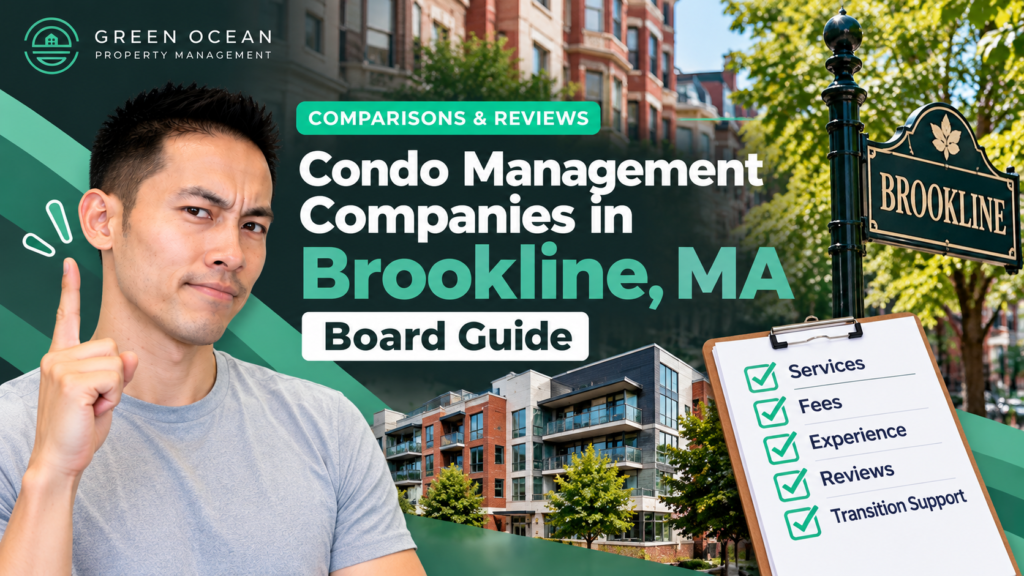
Condo Management Companies in Brookline: Board Guide
How should a Brookline condo board compare management companies? Compare written proposals for scope, staffing, maintenance, financial reporting, fees, and transition support. This guide summarizes services companies describe on their own websites; it is not an independent ranking. Green Ocean Property Management publishes this guide and is one of the providers listed. Verify each firm’s…

DIY Property Management vs. Professional Services
Short answer: Self-managing can suit an owner with the time, local availability, and experience to handle leasing, rent collection, maintenance, records, and tenant communication. Professional management may be a better fit when those duties compete with work, the owner lives far away, or the property portfolio and day-to-day needs are more complex. Compare the total…
CMCA vs AMS vs PCAM: What Your Condo Manager’s Credentials Mean
CMCA, AMS and PCAM are the three credentials you will see most often on a condo manager’s resume. They build on each other. The CMCA is the entry exam. The AMS adds two years of experience and more coursework. The PCAM is the highest designation, and it takes at least five years in the field…
4.9 stars on 1,000+ Google reviews. Managing Boston property since 1977.